In 1956, the Gower Peninsula became the first area in the United Kingdom to be designated an Area of Outstanding Natural Beauty. This southwestern corner of Swansea holds a distinction that extends far beyond its conservation status; beneath its limestone cliffs lies evidence of human presence stretching back to the very dawn of modern humans in north-west Europe.
The Red Lady of Paviland
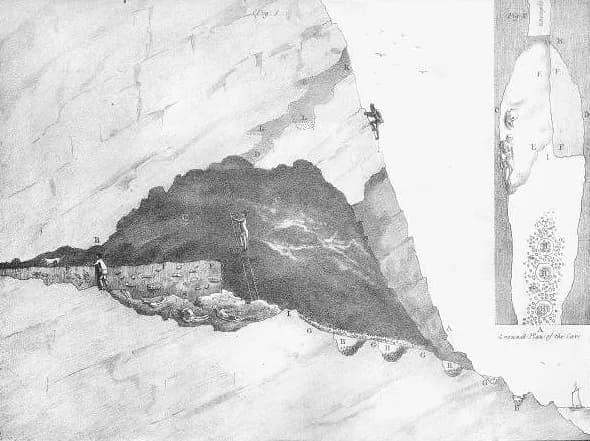
The peninsula's most celebrated archaeological discovery came in 1823, when geologist and theologian William Buckland excavated a partial skeleton in Goat's Hole Cave, a limestone shelter between Port Eynon and Rhossili. The remains, stained with red ochre, became known as the Red Lady of Paviland. Buckland initially believed he had found the remains of a female Roman prostitute, but subsequent analysis revealed something far older.
Modern radiocarbon dating has established that the burial occurred approximately 34,000 years ago, placing it among the oldest known ceremonial burials in Western Europe. The skeleton is now understood to be male, not female, and the careful application of ochre suggests deliberate ritual practice. The remains currently reside in the Oxford University Museum of Natural History.
A Timeline of Deep Time
The Red Lady is not an isolated discovery. The limestone caves of Gower contain a near-continuous record of human and animal activity spanning more than 100,000 years.
Long Hole Cave, located on the slopes of Longhole Cliff, has yielded Aurignacian artefacts dated to approximately 37,000 years ago. These finds represent some of the earliest evidence of modern humans in Britain. At Cathole Cave, archaeologists discovered a rock drawing of a red deer dated to between 15,000 and 12,000 years ago; this may constitute the oldest cave art found in Great Britain.
Other caves tell a story of earlier inhabitants. Remains of Pleistocene animals, including straight-tusked elephants, narrow-nosed rhinoceros, and bison, recovered from Bacon Hole and Minchin Hole, date to between 130,000 and 87,000 years ago. The Parc Cwm long cairn, a Neolithic chambered tomb near Parkmill, was constructed around 6,000 years ago.
The Birth of British Landscape Protection
Gower's conservation credentials are equally historic. Following the National Parks and Access to the Countryside Act 1949, the majority of the peninsula received AONB status in 1956. This made Gower the first protected landscape in Britain, establishing a precedent that would eventually encompass 46 National Landscapes across England, Wales, and Northern Ireland.
The designation covers 188 square kilometres, including the peninsula's highest point, The Beacon at Rhossili Down, which rises to 193 metres. It encompasses the celebrated beaches of Rhossili Bay, Oxwich Bay, Three Cliffs Bay, Langland Bay, Caswell Bay, and Port Eynon Bay. The northern coast features extensive salt marshes and cockle-beds; Gower salt marsh lamb received Protected Designation of Origin status in 2021 under UK law and in 2023 under EU law.
In November 2023, AONBs in England and Wales rebranded as "National Landscapes", though the legal designation remains unchanged.
Gower and Swansea Today
Administratively, Gower has formed part of the City and County of Swansea since 1996. The peninsula, with a population of approximately 76,400, represents the south-western extent of the unitary authority. The area falls within the Swansea travel-to-work area.
The AONB designation brings planning controls comparable to those in national parks. Development is restricted, and the landscape's special qualities, including its geological significance and archaeological heritage, receive statutory protection.
What the Caves Reveal
The archaeological importance of Gower lies in the exceptional preservation conditions within its limestone caves. The Red Lady burial, with its ochre staining, indicates not merely habitation but ritual behaviour; the presence of artefacts alongside the remains suggests deliberate placement rather than casual disposal.
Long Hole Cave's Aurignacian tools connect Gower to a wider European culture that emerged around 40,000 years ago, characterised by worked bone, antler, and ivory alongside stone implements. The Cathole Cave deer drawing, if confirmed as the oldest in Britain, demonstrates that the peninsula's inhabitants possessed not only practical skills but artistic expression.
Visiting Gower's Heritage
Several of the peninsula's archaeological sites remain accessible to visitors, though some caves are protected to preserve their scientific value. The Gower Way footpath traverses much of the AONB, offering walkers views of the landscapes that have attracted human settlement for millennia. Worm's Head, the tidal island at Rhossili, becomes accessible via a causeway at low tide.
The caves themselves, particularly Paviland Cave, represent a physical connection to the deep past. Standing at the entrance to Goat's Hole, looking out over the Bristol Channel, visitors occupy the same vantage point that Paleolithic hunter-gatherers chose 34 millennia ago.